
It’s impossible to fully measure all the hard work and collaboration of First Nations, our many partners, and the ecosystem of land, housing, and financial professionals that continue to provide First Nations people with pathways to homeownership. Of course, First Nations communities themselves are also invaluable in supporting potential homeowners to undertake the financial journey.
Looking back on 15 years of the First Nations Market Housing Fund (the Fund) and 2024, we can use numbers to communicate some successes in advancing sustainable housing opportunities. Let’s celebrate the FNMHF team’s contributions and our shared wins as we look forward to another year of building!
Serving First Nations
Engaging more partners is crucial to the Fund’s momentum. As more First Nations become aware of the Fund’s housing loans as a driver of economic prosperity, more community members will edge closer to homeownership. In 2023, the Fund had 126 First Nations Credit Enhancement clients; in 2024, it had 128 Credit Enhancement and 95 Capacity Development clients.
With 266 applications to date, 43 are under review, and 41.63% of First Nations are being served. This map reflects which First Nations are approved to work with the Fund and the national scope of the interest in its impacts.

This map reflects the number of units subject to Fund-backed loans in each province or territory and the sum of loan amounts in each province.

Successful Credit Enhancement
At the end of 2024, the FNMHF has built successful relationships with select lenders to secure and guarantee $108,860,000 in housing loans. One indicator of the Fund’s successful Credit Enhancement activities is that the FNMHF has not paid any claims to lenders at this point. $15,660,000 (14.38%) of the amount secured has been repaid by borrowers.
This reflects the great work First Nations have done with the Fund to determine several factors, including:
-
- Which lenders to work with
-
- What kind of loans they want to support
-
- The terms of the loans
-
- Who is eligible to borrow
-
- Which lands are eligible
-
- What the loans may be used for
The goal is to achieve optimal community investment and successful repayments to lenders based on each situation. How funds are used may reflect historical factors, such as when most housing was built, and environmental factors, like flooding.
Since its inception in 2008, the Fund’s Credit Enhancement Facility has supported the construction, purchase, refinance, or renovation of 604 units on reserves across the nation. This is up from 533 units in 2023 and 497 in 2022.
This chart shows how homeowners and future homeowners have used, or are using, their funds.

Strategic Capacity Development
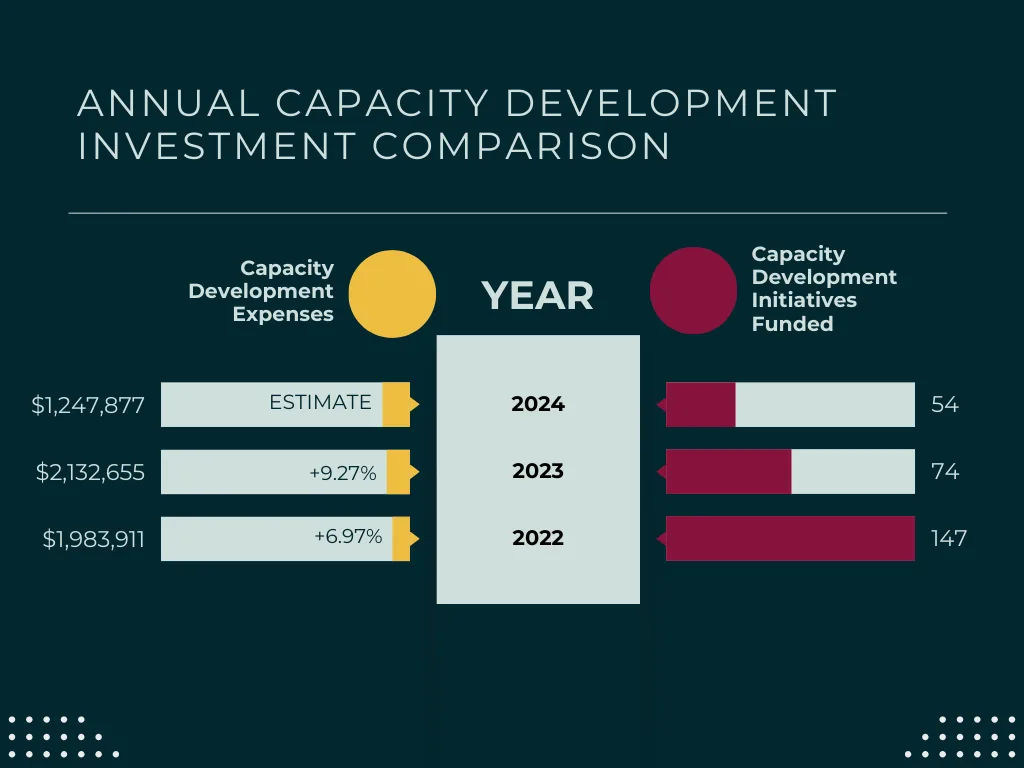
In 2024, the Fund continued to focus on transitioning Capacity Development clients nearing eligibility for Credit Enhancement into that program. However, more First Nations continued to benefit from programs that will foster their readiness. 2022 was a milestone year for Capacity Development, marking over $26 million invested in capacity-building initiatives in First Nations communities.
To date, 166 First Nations have benefitted from 1,691 Capacity Development initiatives. This graph demonstrates that while the Fund is being more strategic about the initiatives it funds, the amount invested in Capacity Development is outpacing the rate of inflation.
Check out May’s Understanding the First Nations Market Housing Fund’s Programs & Services blog post for more information on the Fund’s Credit Enhancement and Capacity Development programs.
Advancing engagement and collaboration
This year, Fund staff participated in or presented at no less than 22 in-person events across the nation, including ten in-person events since November. The events were hosted by over 31 organizations, including our close allies, such as the Aboriginal Financial Officers Association (AFOA), First Nations professional groups, such as the National Aboriginal Lands Managers Association, and government stakeholders.
Making new connections, participating in panel discussions, and presenting on housing programs and initiatives increases awareness of the Fund’s activities. This face-to-face activity also provides opportunities for support staff to learn from partners and stay excited about the work. The Role of Networking to Achieve Your Goals as a First Nations Community, posted in April, explores more on this topic.
The Fund will be back on the road in February 2025, visiting Calgary for the Assembly of First Nations (AFN) National Housing & Infrastructure Forum and Halifax for the AFOA Canada National Conference. Here’s to another productive year in 2025!