
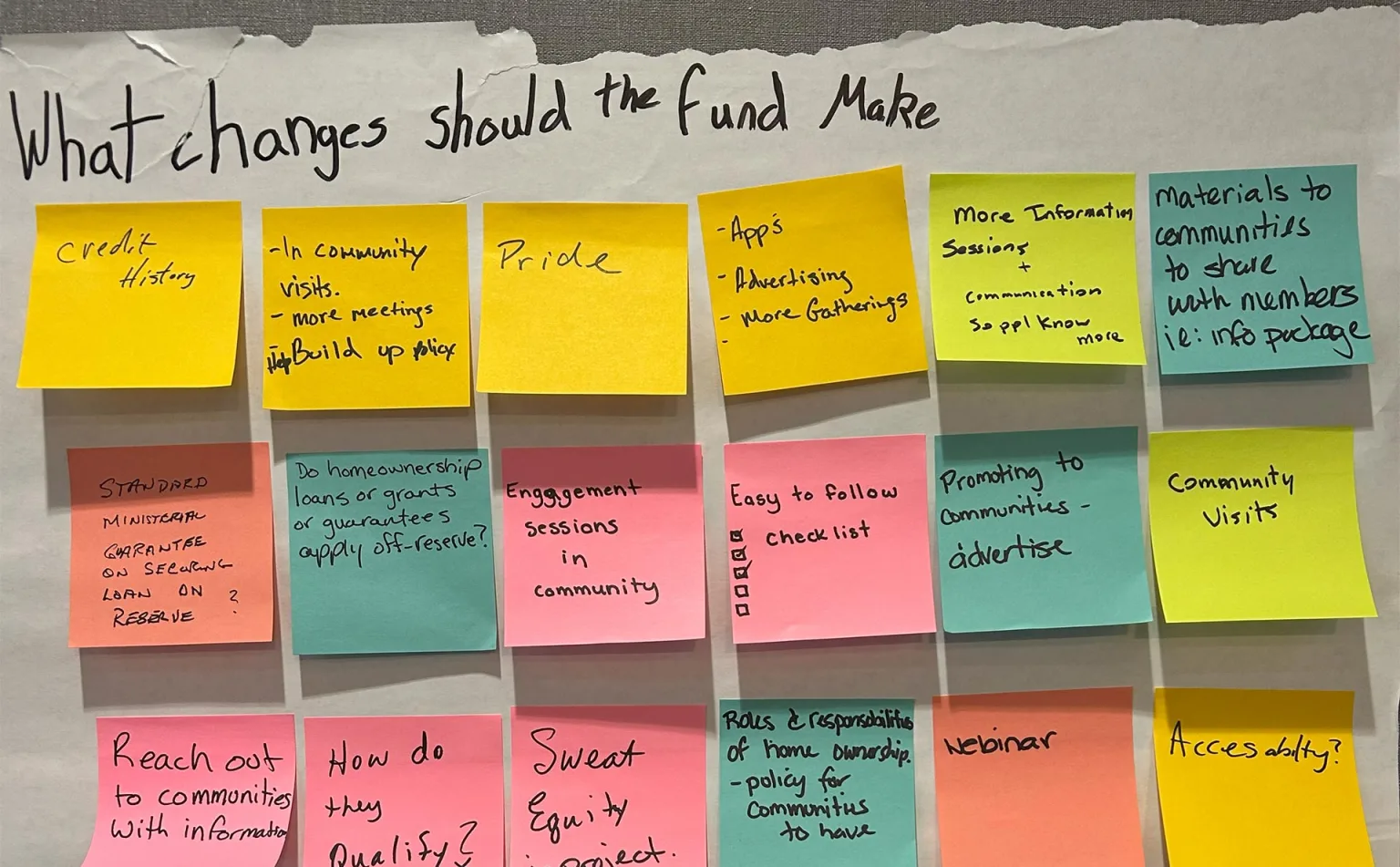
Following an updated resolution by the Assembly of First Nations (AFN) Chiefs Committee on Housing in July 2024, the Fund renewed community engagement begun in 2018. This recent round of seven in-person and online sessions focused on the options for First Nations control and the future role of the Fund. Three of those sessions were held with community members in Montréal, Kamloops, and Dartmouth, while other First Nations individuals joined in online sessions divided into East, West, and Central.
The Fund has advocated for a membership model to increase engagement with First Nations communities. When facilitators asked what changes were needed and what transfer of care and membership models would look like, participants were overall interested in:
- Online and in-person face time and other communications channels with the Fund
- More education and mentorship opportunities for community members
- Simpler processes with plain language and less paperwork
- More flexibility in how housing loans are used
Ownership, empowerment, and self-determination also emerged as strong themes in community responses, and the report encouraged readers to read more direct feedback from participants. This blog highlights statements that come from community about self-governance, accountability, and control.
Self-determination in the transfer of care
When asked about the transfer of care, a Central participant said: “It makes me think of First Nations fully managing the fund, deciding where resources go based on their needs and priorities.”
“This indicates a shift towards self-determination, empowering First Nations to decide how funds are utilized for housing and development projects.”
- Participant, West
Many participants felt that control of the Fund would lead to autonomy, where “community-led policies and initiatives [are] treated as major priorities.”
“The proposal advocates for First Nations to have complete ownership and control over the Fund, enabling these communities to establish their own priorities and strategies.”
- Participant, West
In the west, a Kamloops participant pointed to “freedom to use funding that suits individual community wants and needs” as a key element of self-determination.
A recognition of First Nations
Wide participant feedback was that First Nations control would empower First Nations communities make decisions and govern themselves, modeling autonomy and self-determination.
In the East, participants’ positivity about the transfer of care projected impact beyond housing. In Dartmouth, participants believed the transfer would lead to “recognition of First Nations.”
“a step in the right direction” “the best decision to ever happen”
- Eastern participants react to the future transfer of care
Embedded cultural relevance
The report observes that overall, participants felt that services would be more
culturally relevant if First Nations communities were the decision-makers.
A Central participant offered a simple explanation for how this would happen. Centreing community needs and initiatives through First Nations control would place “more emphasis on culture and its relevance.”
“It suggests a shift in decision-making authority to local leaders ensuring that the Fund reflects cultural values and meets the needs of the community.”
- Participant, West
Participants described the cultural impact as having culturally relevant procedures, culturally relevant programs, housing policies that honour traditional values and communal living approaches, and culturally specific approaches. They also foresaw that it would foster an ethic of care, making a comparison to government control.
Independence from outside governments
A sentiment from the Eastern group was echoed across sessions. “Taking away government control can empower First Nations to create programs that are more relevant to their cultural needs and more effective for their communities.”
The report says that “by and large, participants criticized the government, conveying a general sense of mistrust.” Concerns with government control included being set up to fail, jumping through hoops to receive funding, delays, bureaucracy, a lack of cultural relevance in programs and policies, and overlooking communities’ needs. Online, an Eastern participant stated that “government oversight often creates delays and doesn’t always reflect the realities of First Nations communities.”
“Granting full control aligns with the principles of self-governance and ensures that the program remains culturally relevant.”
- Participant, West
A Central participant offered that “transferring control empowers First Nations to take full responsibility for their housing challenges and solutions,” while one in Dartmouth characterized the transfer as “freedom from government control.” Another’s response adds to this by saying that “removing government control [will] let First Nations design programs that align with their culture and needs.”
Individual Western session participants believed that First Nations control and autonomy meant designing and managing services that truly reflect their realities and aspirations, more options for on-reserve housing for First Nations, more services, and more efficient services.
The reports remarked that other Western participants are confident that First Nations communities will be able to make decisions faster than the government.
Models of governance and community-based accountability
Feedback on models for the Fund’s self-governance included establishing accountability mechanisms to self-monitor. “It could look like transparent reporting systems led by First Nations to track progress and build trust,” offered a participant from the Central session.
On the community level, participants suggested bringing community members into the decision-making process and the Nations being responsible for regular community engagement on housing.
“The vision is for a decentralized model where each community independently oversees its share of the fund.”
- Participant, West
The Montréal group’s exploration of self-determined control of the Fund emphasized accountability to community and community-based leadership models. A couple of participants envisioned a collective extending beyond chiefs, with “organizations and individuals” playing an ownership role.
“I imagine communities having their own leadership structures in place to govern and make decisions about housing projects.”
- Participant, Central
“It looks like a system where First Nations handle everything, from budgeting to project management, with minimal outside interference,” shared a Central participant. Many Central participants felt it important that First Nations have control of the entire process, through to implementation, for local accountability. “I see a system in which First Nations create policies, run operations, and evaluate results through their own governance frameworks.”
One Eastern participant added that First Nations should have oversight in the day-to-day operations of the fund, while another emphasized the need to create a framework that allows for self-sustaining control.
The question “What does ‘Transfer of Care and Control of the Fund to First Nations’ mean to you?” elicited a specific response from an Eastern participant. “The phrase indicates that First Nations should have complete authority over the allocation and use of funds, aligning with their own priorities and values. Ideally, this would mean that board councils led by First Nations would directly manage these funds.”
Conclusion
The desire for self-determination affirmed the need for more awareness in communities and elicited words of caution from two Eastern participants. One suggested that Nations engage their communities further and the Fund collaborate with Nations to ensure the essential resources and safeguards are in place before transferring control. To aid in Nations’ increased responsibilities in this transition, “a comprehensive support system should be established,” recommended the other.
Finally, participants supported the need for an Annual General Meeting. The first will be held alongside the AFN’s Special Chiefs Assembly at the Rogers Centre in Ottawa, on December 4, 2025.
This blog outlined only one area of community feedback. For full insight into other overarching findings and feedback from the Fund’s existing clients, please read the National Engagement Summary Report.