
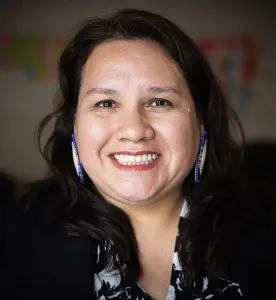
 Since attending her first Trustee meeting in 2020, Chair of the First Nations Market Housing Fund (FNMHF) Board of Trustees Kathleen BlueSky has thoughtfully weighed how culture, hard work, and passion make the Fund one of the most impactful boards that she’s been a part of.
BlueSky has over 20 years of experience in finance, strategic planning, and business development. In this blog, BlueSky shares her vision for the future, takes us behind the scenes of chairing the Board of Trustees, and reveals the superpower that can drive Indigenous growth, autonomy, and prosperity.
Grounding in culture, family, and community
Each board meeting begins with a rotating opening protocol, with members bringing the protocols from their territories to the proceedings. “We want our identities, we want our way of life reflected in the work we do every day, every meeting, every call,” says BlueSky.
Review for a meeting may include 60 to 70 documents. “Everybody comes motivated to advance this agenda, because it’s so close to home. We know our housing needs at a community level and a regional level. Our work is rooted in love for the people and wanting to create healthier, stronger communities, where people have safe homes.”
She credits her family and motherhood as her grounding and driving forces as she manages the competing responsibilities of chairing the board, serving as CEO of Seven Feathers Consulting, working at Treaty One Development Corporation, and continuing her Co-Founder role as Chair of Wiijii’idiwag Ikwewag (Women Helping Each Other). “When I take on these huge responsibilities, I think of them as getting back to the values that we’ve always had, but in a more contemporary context.”
“We always had safe, loving homes for our families, and we’ve got to get back to that, because we cannot sit around and wait for the government to fund us to build safe homes. Because they never will. We'll be waiting forever.”"
BlueSky explains that the example the First Nations Market Housing Trust sets as a First Nations-led and First Nations-governed fund is especially important when so many First Nations are settling claims with the federal government.
“There’s these huge transactions that are going to be happening, and hundreds of millions of dollars flowing to community. A majority of them are going to want to create a trust to manage that.”
A personal homeownership experience informs the membership model
BlueSky was 28 years old and expecting her first child when she attended a homeownership webinar through her bank. Walking through the process from putting in an offer to the cost of closing with a realtor, home inspector, and lawyer made buying a home feel achievable. She not only started informing and encouraging her family, but also brought that enthusiasm to explaining how the Fund’s new membership model positions community members to have a shared ability to navigate the on-reserve homeownership process.
“The information that I got from that workshop was so simple, and that's what we as a fund need to be doing for community members. We need to create those spaces for people to learn the process, because they have the capacity. If they're interested in homeownership, we can provide direct supports and resources and have their backs while they talk that language and move towards it.”"
The second layer, she says, is about “having more of the community voice to drive what we’re doing and creating that demand” within their Nations. The September 2025 blog and the National Engagement Summary Report provide additional community feedback on the membership model framework.
A “BlueSky” vision
From the Nisichawayasihk Cree Nation and Minegoziibe Anishinabe First Nation, BlueSky’s vision is influenced by Cree and Anishinabe teachings. When asked if she has a “blue sky” vision for the future, she responds that she daily envisions the sky and the sun, channelling that energy into whatever it is that she’s doing. “In our belief system, there is no separation between spirit and physical realm.”
BlueSky is a firm believer in the capacity of First Nations people.
“Belonging in any space that you want to be in is the first capacity we have. We have the capacity to dream of our role or purpose. If you listen to that, the rest is going to follow, because that actually comes from spirit.”
“When our spirit is pushing us to do something, it's because of what we've lived through, and maybe not us, but it could have been my grandparents, my parents, my great grandparents; they lived through something that I carry, and my spirit is telling me to go and do this right. Some people call it intuition, but it's so much more than that. It is spirit, and it's our superpower. Our people are not paying attention to it, but it's there.”
A systems perspective on Indigenous futures and belonging
Her experiences working with First Nations youth in North Winnipeg influenced BlueSky to pivot from starting a Master’s in clinical psychology to pursuing a Master’s in Business Administration (MBA). “This is not at all what our people need,” she thought of the disconnect between the needs of the youth she was serving–and the foreign systems they were forced to navigate.
Fluency in capital, governance, leadership, and management, she felt, could prepare First Nations to build wealth and engage in Nation Building. She has devoted her career to advancing to wholistic well-being, economic independence, and self-governance to create change at a systems level.
BlueSky is a firm believer in the capacity of First Nations people.
“One of my personal values is building structures that outlast any one person. So, strong boards, strong policies, bankable projects, and creating those talent pipelines. Like creating a workplace where people want to come and work, so you don't ever have to worry about not having the next generation of leadership. So to me, that's always my main focus.”
Leadership on the board
BlueSky’s explanation of her responsibilities also demonstrates both her diplomatic and strategic skills as an architect of change.
“Governance and leadership are the Chair’s two core responsibilities. We have mechanisms in place to hold each other accountable as leaders.”
“Strategic direction towards achieving our mission is important, because we’re coming to the table saying this is the direction we need based on our corporate, financial, our community experience. To be ready in the future for the change we see coming and be prepared for future opportunities.”
BlueSky keeps the trustees aligned and informed by talking to them between meetings, asking where they want to go, and what they’re thinking. Her ability to listen, decipher meaning and intention, and synthesize those conversations fosters directional harmony while incorporating all perspectives.
“What is important when you're collaborating is that you can never just pursue the strategy of the strongest voice or the loudest speaker. Ensuring that everybody is heard, and that we integrate everybody's ideas and feedback, is the whole point of having a board or having a collaborative relationship.”
Inside board priorities
BlueSky identifies risk stewardship as a frequent topic at committee meetings, and relationships as a core responsibility. “In every meeting, it’s always about what are the financial, legal, operational risks, and how do we mitigate them? Because we’re a trust fund, we have to be very diligent in that regard. So it does form a lot of our day-to-day work.”
“With Travis as the new CEO, two years ago, we’ve been really focusing on relationships with partners like our national organizations, tribal councils, and communities that are doing really innovative things in housing.”
Transfer of Control
The transfer of care and control has been the top priority since BlueSky was appointed Vice Chair and transitioned to Chair. She hopes that the decision will be ratified in the next year or two, and her blue sky goal is for within the next 18 months.
“Then we need a strategic plan for three to five years on how this unfolds, and really the biggest accelerator of this happening is the alignment between the trustees, the leadership, and nations moving together with one plan. There is a lot of faith in what we're doing at the First Nations Market Housing Fund, and we've also built a lot of trust and collaboration with the federal government.”
Concrete systems change
BlueSky offers improvements with lenders as a positive sign of the Fund’s role in changing the landscape for on-reserve homeownership. She describes meeting with commercial lenders before creating an urban reserve. She said, “A major investment is coming into Manitoba. You gotta sort your stuff out in terms of mortgages, because there’s going to be people building homes here. And so they figured it out. It took a matter of six to eight weeks of conversations to land with a leasehold interest.”
The Fund, she says, has done crucial onboarding of lenders, and these outcomes are becoming common in many other areas. “It just takes that communication and creating that understanding. I think the capacity is there for everybody, and we just have to inspire that action.”